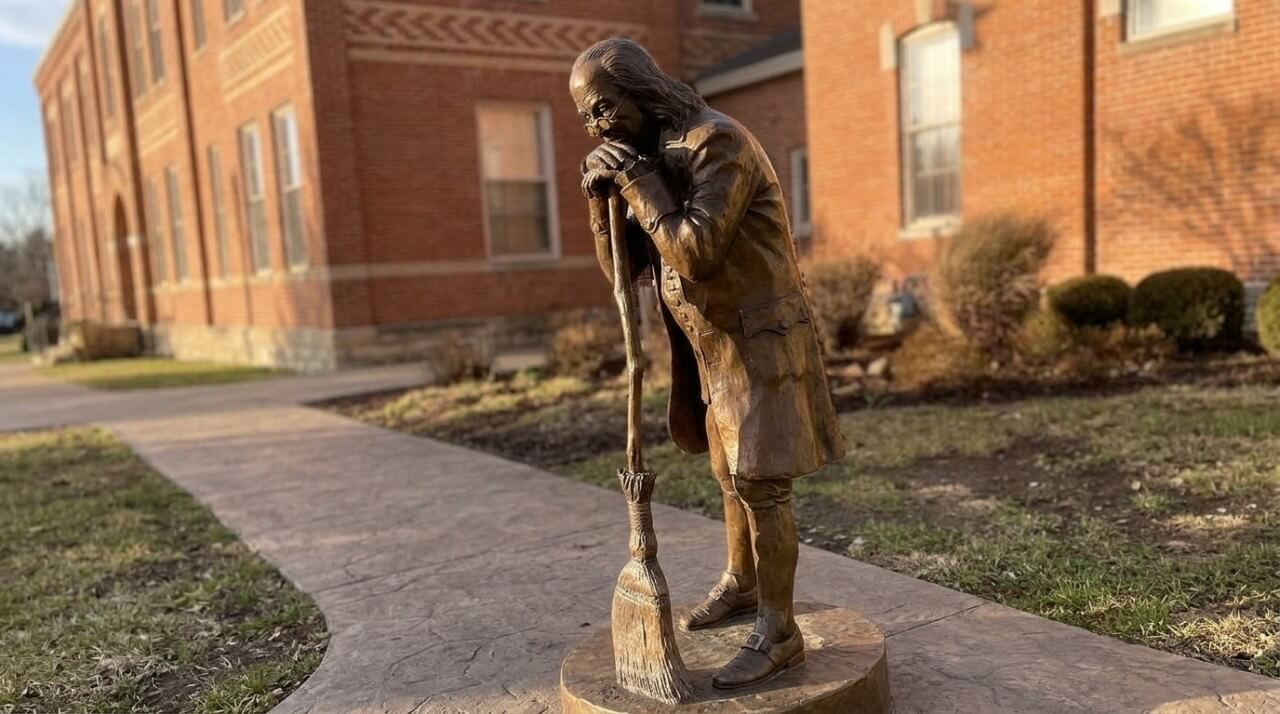
Benjamin Franklin supposedly once discovered a stray seed caught in an imported whisk broom, planted it, and accidentally helped establish an American agricultural industry.
Not bad for someone who was already busy with electricity, printing, and politics.
According to the popular story, that single seed grew into broomcorn, a plant eventually used to manufacture countless American household brooms.
Unfortunately, historical evidence doesn’t confirm that Franklin introduced broomcorn to America. His surviving correspondence tells a different story, one involving seeds already available in colonial Virginia and a genuine interest in sharing useful plants.
So how did Franklin become the supposed father of American broomcorn, and what actually happened?
How Benjamin Franklin Became Part of Broomcorn History
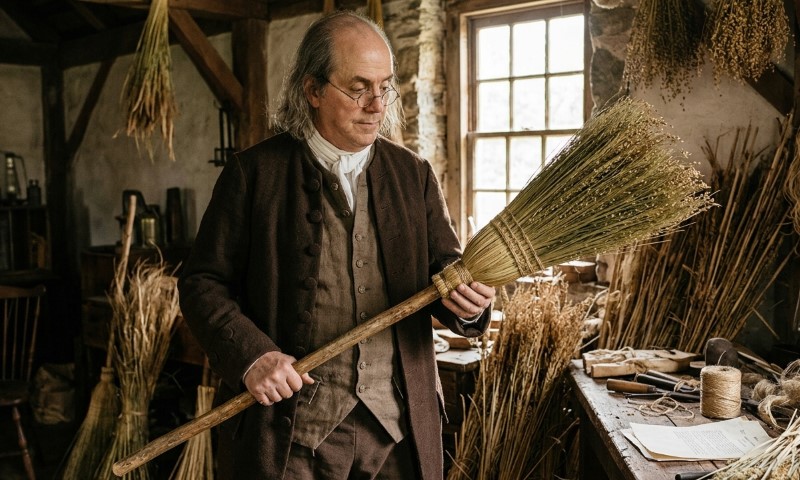
Franklin had a reputation for spotting practical opportunities in ordinary things. His experiments, inventions, and agricultural interests made him an excellent candidate for a story about turning an overlooked seed into a valuable crop.
Popular versions describe Franklin examining a whisk broom imported during the early 1700s. Upon discovering seeds tangled in its fibers, he supposedly planted them and recognized their potential for producing stronger, more effective brooms.
Several retellings even suggest that America’s broomcorn industry began with that single discovery.
By January 13, 1929, the story was familiar enough to appear in a New York Times article titled Franklin’s Gift of Brooms to the American Housewife.
Yet repetition creates an interesting historical problem. A story appearing in newspapers, agricultural publications, and local histories can establish its popularity without proving the original event occurred.
One important distinction also gets lost in the telling.
Introducing a crop and promoting an existing crop are two different achievements. Introducing means bringing a plant into a region where it was not previously cultivated. Promoting means encouraging people to grow something already available.
Franklin’s letters provide substantial evidence for the second achievement.
What Franklin’s Letters Actually Reveal
Fortunately, historians don’t have to rely entirely on colorful stories. Franklin left behind correspondence describing his interest in broomcorn.
On February 21, 1757, he wrote to his sister, Jane Mecom, enclosing seeds he called “whisk seed.”
In the letter, Franklin described the plant as useful for feeding animals, producing thatching material, and making small brushes used on velvet.
He also offered cultivation instructions, explaining that the seeds should be planted in hills, much like Indian corn.
Most importantly, Franklin explicitly identified Virginia as the place where he obtained the seeds.
That detail changes the story considerably.
Instead of describing a mysterious seed discovered in an imported broom, Franklin was distributing planting material he had acquired within colonial America.
His correspondence also instructed Jane to share seeds with Samuel Cooper and James Bowdoin.
A second letter, dated March 24, 1757, provides even more detail.
Writing to Samuel Ward, Franklin described “Whisk Corn, or Broom Corn” and recommended planting three or four grains in each hill.
He explained that the plant could grow approximately 10 feet tall, required sufficient space, and produced useful material for brushes, brooms, animal feed, and thatching.
Franklin also described removing the seeds after harvesting, a practical detail that would help recipients prepare the plant for use.
Both letters appear in Volume 7 of The Papers of Benjamin Franklin, covering October 1756 through March 1758.
Taken together, these documents establish something more reliable than the whisk-broom legend.
Franklin was actively distributing broomcorn seeds and explaining how to cultivate them. Nothing in either letter establishes that he discovered the plant accidentally or introduced it to the colonies.
Was Broomcorn Already Growing in America?
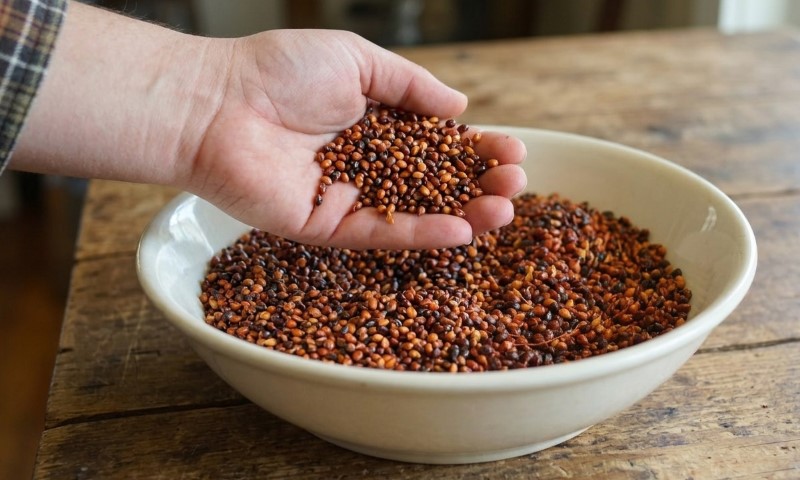
Broomcorn’s history becomes considerably more interesting once Franklin is no longer treated as its starting point.
Despite its name, broomcorn isn’t actually corn. It belongs to the sorghum family, with modern classifications generally placing cultivated sorghums within Sorghum bicolor.
Sorghum originated in Africa, where agricultural communities cultivated it for food and other practical purposes over thousands of years.
Its movement to other continents involved extensive agricultural knowledge, trade, migration, and the forced movement of enslaved Africans.
However, an important distinction matters here.
Sorghum includes several cultivated forms, and evidence that sorghum existed in a particular region doesn’t automatically establish that broomcorn was growing there.
Broomcorn was selected specifically for its long, fibrous flowering branches, which provide the material used in traditional broom heads.
Historical agricultural research indicates that specialized broomcorn varieties were cultivated in Mediterranean regions centuries before Franklin’s lifetime.
What Other Historical Records Tell Us
Thomas Jefferson also mentioned broomcorn among the crops cultivated on Virginia farms in his Notes on the State of Virginia, written during the 1780s and published in 1785.
His account independently confirms that broomcorn was part of Virginia agriculture during the late colonial and early American period.
Jefferson’s reference doesn’t establish exactly when the crop first arrived. It does, however, support the evidence that broomcorn cultivation was established in Virginia.
An even more revealing investigation came through Dr. Sam Moyer, who spent years researching broomcorn history and searching for the original evidence behind Franklin’s supposed discovery.
Moyer encountered repeated references to the legend, including claims involving an elusive 1725 diary. However, his investigation failed to locate reliable documentation confirming the famous incident.
In a response to Moyer’s 2002 inquiry, Kate M. Ohno, then an assistant editor of The Papers of Benjamin Franklin, concluded that Franklin promoted broomcorn rather than introduced it.
One especially telling detail concerns the timing.
Franklin visited Virginia during the spring of 1756, approximately a year before sending seeds to Jane Mecom.
His correspondence therefore fits a straightforward explanation: he encountered a useful crop during his travels and subsequently encouraged others to cultivate it.
No miraculous discovery is necessary.
So, Did Franklin Really Start America’s Broomcorn Crop?
View this post on Instagram
Available evidence supports a fairly simple conclusion: Franklin helped distribute broomcorn, but historians cannot reliably credit him with introducing it to America.
His actions were still significant.
Sharing viable seeds, explaining planting requirements, and describing practical uses could encourage cultivation in additional communities.
Franklin understood something that mattered to early American households. A crop capable of supplying brush material, animal feed, and thatching had several useful applications.
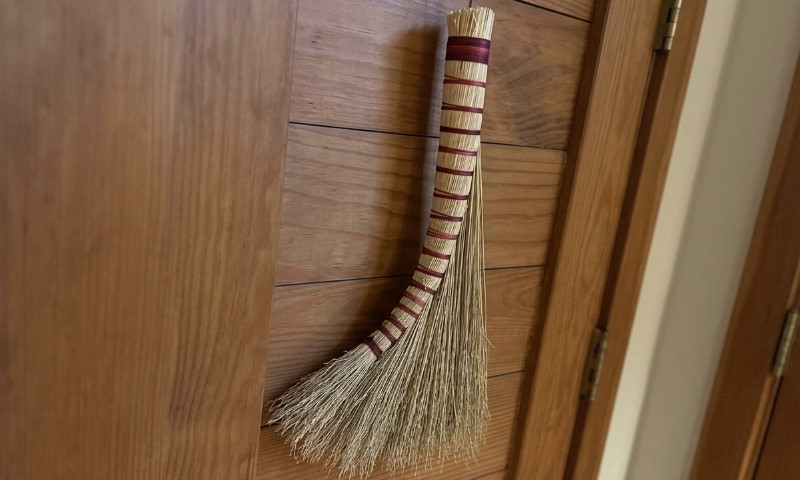
Broomcorn eventually became an important material for traditional American corn brooms.
Its long, relatively stiff seed-head branches could be harvested, dried, cleaned, and bound around wooden handles to produce durable sweeping tools.
For perspective, a University of Kentucky agricultural publication estimates that around 60 broomcorn heads are needed to make one broom.
That helps explain why cultivating broomcorn became an agricultural activity rather than merely an occasional household experiment.
Commercial cultivation expanded during the 19th century, with Illinois becoming a leading producer during the 1860s.
Franklin’s role belongs near the beginning of that documented American history, but not necessarily at the beginning of the crop itself.
A Good Story, but a More Interesting History
An inventor discovers a seed in his broom, plants it, and changes American housekeeping. It’s an excellent story, particularly with Benjamin Franklin as its central character.
Unfortunately, an excellent story isn’t automatically an accurate one.
Franklin’s surviving letters establish a more modest but genuine contribution. He obtained broomcorn seeds in Virginia, recognized their practical value, and encouraged others to grow them.
Meanwhile, broomcorn’s broader history involved centuries of cultivation, agricultural knowledge, and craftsmanship long before the familiar American corn broom became a household staple.
Franklin didn’t need to discover a mysterious seed to make a meaningful contribution. Sometimes recognizing the value of something already growing is achievement enough.